Madrid City Tour tourist bus routes

Discover Madrid at your own pace with a Hop On Hop Off route with stops, designed so you can explore the city with complete freedom. Hop on the Madrid City Tour bus, enjoy the best panoramic views, and hop off whenever you like to visit the must see sights in the Madrid city centre, from grand avenues and historic squares to museums and landmarks.
The service includes 34 stops across 3 routes, so you can hop on and off as many times as you want and mix areas depending on your plans. Check the route, timetables and stops of the Madrid City Tour bus to make the most of your trip!

Route 1: Historic Madrid
Available all year round. Explore the most iconic side of Madrid while admiring Paseo del Prado and the architectural gems of the Austrias, such as the Royal Palace and Puerta de Alcalá.


Route 2: Modern Madrid
Available all year round. Discover Madrid’s most innovative side with its museum district, ministries, and contemporary architecture. Visit the iconic Santiago Bernabéu Stadium and the KIO Towers
Route 3: Current Madrid
Discover today’s Madrid, a city in constant evolution where tradition and modern life coexist. On board the Madrid City Tour bus, enjoy a comfortable hop-on hop-off sightseeing experience to explore the capital’s most contemporary side at your own pace.
Map of Routes and Attractions in Madrid

Plaza de Neptuno in Madrid is one of the main landmarks along Paseo del Prado and the starting point for all three Madrid City Tour sightseeing bus routes: Route 1: Historic Madrid, Route 2: Modern Madrid and Route 3: Madrid Today. Hop on at this stop to begin a panoramic tour of the capital’s main monuments, squares and neighbourhoods.
What is Plaza de Neptuno?
Plaza de Neptuno is the popular name given to Plaza de Cánovas del Castillo, which is dominated by one of Madrid’s most famous monumental fountains. Its central figure depicts Neptune, the Roman god of the sea, holding a trident while riding a shell-shaped chariot pulled by two sea horses.
The fountain formed part of the project to renovate the former Salón del Prado during the reign of Charles III. It was commissioned from the sculptor Juan Pascual de Mena and completed by several other artists following his death. The work was finished in 1786, and the monument was moved to the centre of its current location in the late 19th century.
Where is Plaza de Neptuno?
Plaza de Neptuno in Madrid is located in Plaza de Cánovas del Castillo, in the heart of Paseo del Prado. It lies between Plaza de Cibeles and Glorieta del Emperador Carlos V, in an area closely associated with the city’s art, culture and history.
Nearby attractions include the Prado National Museum, the Thyssen-Bornemisza National Museum, the Spanish Congress of Deputies, the Literary Quarter and some of Madrid’s best-known historic hotels.
How can you get to Plaza de Neptuno?
You can easily reach Plaza de Neptuno with Madrid City Tour, as this stop is the starting point for all three sightseeing bus routes. Route 1: Historic Madrid, Route 2: Modern Madrid and Route 3: Madrid Today all depart from here, allowing you to explore different areas and attractions across the capital.
Thanks to the hop-on hop-off system, you can begin your journey at Neptuno, get off at any stops you would like to visit and hop back on later to continue the route.
What can you do in Plaza de Neptuno?
The location of Plaza de Neptuno allows you to combine art, nature, architecture and cultural entertainment in a single visit. You can begin by admiring the details of the Neptune Fountain before walking along Paseo del Prado, with its gardens, fountains and historic buildings. Nearby you will find the Prado Museum and the Thyssen-Bornemisza National Museum, as well as the Literary Quarter and the Royal Botanical Garden. You can also continue your walk towards El Retiro Park or check the cultural programmes at Teatro de la Zarzuela and Círculo de Bellas Artes.
What can you see near Plaza de Neptuno?
The Plaza de Neptuno stop is an excellent starting point for visiting some of the main cultural and natural attractions in central Madrid.
- Teatro de la Zarzuela: Located behind the Spanish Congress of Deputies, it is the first and only theatre specifically dedicated to Spanish lyric theatre. It opened in 1856 and offers a programme focused on zarzuela, Spanish opera and other musical genres.
- El Retiro Park: One of Madrid’s largest green spaces. You can reach the park by walking along Calle Felipe IV or Calle Alfonso XII and visit landmarks such as the Great Pond, the Crystal Palace and the Statue Walk.
- Royal Botanical Garden: Located next to the Prado Museum, it contains collections of plants from different regions around the world. Its location was chosen as part of Charles III’s project to create a major complex dedicated to the natural sciences in this area of Madrid.
- Círculo de Bellas Artes: Founded in 1880, it is one of the most important private cultural centres in Europe. It organises exhibitions, conferences, artistic activities and film screenings. Its rooftop terrace offers panoramic views over central Madrid and the buildings lining Gran Vía.
Frequently asked questions
How far is Plaza de Cibeles from Plaza de Neptuno?
The walking distance between Plaza de Cibeles and Plaza de Neptuno is approximately 520 metres. The walk along Paseo del Prado usually takes between 6 and 8 minutes, although this may vary depending on your pace and the traffic lights along the route.
What is the history of the Neptune Fountain in Madrid?
The Neptune Fountain was created in the 18th century as part of the Salón del Prado project promoted by Charles III. Designed by Juan Pascual de Mena, it depicts the god Neptune riding a chariot pulled by sea horses and was moved to its current location in the late 19th century.
Which football team celebrates its victories in Plaza de Neptuno?
Atlético de Madrid traditionally celebrates its trophies and major sporting achievements around the Neptune Fountain. The club’s red-and-white supporters gather in the square, while Real Madrid celebrates its victories in the nearby Plaza de Cibeles.
How far is Atocha station from Plaza de Neptuno?
Madrid Atocha station is approximately 1.8 kilometres on foot from Plaza de Neptuno. The walk usually takes around 20 to 25 minutes, depending on which station exit you use. There are also direct city bus connections that allow you to complete the journey in just a few minutes.
Discover one of the capital’s most iconic landmarks by getting off at the Plaza de Cibeles stop on our sightseeing bus. Located in the heart of Madrid, this monumental square is surrounded by some of the city’s most representative buildings and marks the beginning of the famous Art Walk.
Plaza de Cibeles in Madrid, sometimes popularly referred to as Plaza de la Cibeles, is easily recognisable thanks to the fountain at its centre. Surrounding it are the Cibeles Palace, the Bank of Spain, Linares Palace and Buenavista Palace, which together form one of the capital’s most impressive architectural ensembles.
What is Plaza de Cibeles?
Plaza de Cibeles is one of Madrid’s best-known and most photographed urban spaces. It is centred around the Cibeles Fountain, a neoclassical sculptural ensemble depicting the Roman goddess Cybele riding in a chariot pulled by two lions.
As well as being an important junction between some of the main roads in the city centre, the square is one of Madrid’s great symbols. It is also known as the place where Real Madrid supporters gather to celebrate the team’s most important victories and trophies.
Where is Plaza de Cibeles?
Plaza de Cibeles is located in central Madrid, at the intersection of Calle de Alcalá, Paseo del Prado and Paseo de Recoletos. Its location connects some of the city’s main tourist areas, including Gran Vía, Puerta de Alcalá, El Retiro Park and the Art Walk.
How can you get to Plaza de Cibeles?
Hop on our Madrid City Tour sightseeing bus on Route 1: Historic Madrid and enjoy a panoramic tour of the city until you reach the Plaza de Cibeles stop, located at Paseo del Prado, 1. We cannot think of a more comfortable and entertaining way to travel around the city.
You can also take Metro line 2 to Banco de España station, located just a few metres from the square. Alternatively, you can use Recoletos Cercanías railway station or one of the many urban bus routes that pass through this part of the city.
What can you do in Plaza de Cibeles?
The area surrounding Plaza de Cibeles brings together architecture, culture, history and some of the finest views in central Madrid. These are some of the activities you can enjoy during your visit:
- Photograph the Cibeles Fountain and the buildings surrounding the square.
- Enter the Cibeles Palace and visit the CentroCentro cultural space.
- Go up to the Cibeles Palace observation deck to admire central Madrid from above.
- Visit the exhibitions and cultural activities held at Casa de América.
- Walk along Paseo del Prado and explore the museums of the Art Walk.
- Visit Puerta de Alcalá and El Retiro Park.
- Walk along Paseo de Recoletos towards Plaza de Colón.
What can you see in Plaza de Cibeles?
Plaza de Cibeles is surrounded by some of Madrid’s most important cultural venues, monuments and green spaces. From this stop, you can admire its famous fountain, visit several museums, enjoy outstanding views of the city or walk to one of the capital’s best-known parks.
- El Retiro Park: Just a few minutes from Plaza de Cibeles is El Retiro Park, one of Madrid’s main green spaces. Inside, you can walk beside the Great Pond, visit the Crystal Palace, explore its historic gardens or relax among fountains, sculptures and tree-lined avenues. It is an essential visit for anyone wishing to combine nature, heritage and tranquillity in the heart of the city.
- Círculo de Bellas Artes: The Círculo de Bellas Artes is one of Madrid’s leading cultural centres and is located very close to Plaza de Cibeles, on Calle de Alcalá. In addition to hosting exhibitions, conferences, film screenings and artistic activities, the building has a popular rooftop terrace offering some of the finest panoramic views of central Madrid.
- Thyssen Museum: The Museo Nacional Thyssen-Bornemisza forms part of Madrid’s Art Walk and houses an extensive collection tracing the history of European painting from the 13th to the 20th century. Its galleries contain works by artists such as Dürer, Caravaggio, Monet, Van Gogh, Picasso and Hopper, making the museum an ideal stop for completing a cultural visit to the area surrounding Cibeles.
- Cibeles Fountain: The Cibeles Fountain is the square’s most iconic monument and one of the great symbols of Madrid. The ensemble depicts the goddess Cybele, associated with the earth and nature, seated in a chariot pulled by two lions. In addition to its historical and artistic value, the fountain is known as the place where Real Madrid supporters and players celebrate the club’s major trophies.
What is the history of Plaza de Cibeles?
The history of Plaza de Cibeles is connected to the transformation of the Salón del Prado promoted during the reign of Charles III in the 18th century. The aim was to create a grand, tree-lined monumental avenue devoted to science and culture, decorated with fountains such as those of Cibeles, Neptune and Apollo.
The Cibeles Fountain was designed by Ventura Rodríguez in 1777 and built in 1782. Originally, it was not merely decorative, as it also supplied water to Madrid’s residents, water carriers and horses.
The fountain was initially located opposite Buenavista Palace and faced towards the Neptune Fountain. In 1895, it was moved to the centre of the square and placed in its current position, facing the first section of Calle de Alcalá.
Over time, the grand buildings surrounding the monument were constructed, transforming the square into one of Madrid’s most recognisable urban ensembles.
Frequently asked questions
Why is Plaza de Cibeles famous?
Plaza de Cibeles is famous for its monumental fountain, considered one of Madrid’s main symbols, and for the historic buildings surrounding it. It is also internationally known as the place where Real Madrid players and supporters celebrate the club’s major trophies.
What does Plaza de Cibeles represent?
The central feature of the square depicts Cybele, the goddess of the earth, nature and fertility. She is shown seated in a chariot pulled by the lions Hippomenes and Atalanta. Her tower-shaped crown and the keys she holds symbolise her power and her role as protector of the city.
Which metro line takes you to Plaza de Cibeles?
Madrid Metro line 2 takes you to Banco de España station, the closest station to Plaza de Cibeles. From the exit on Calle de Alcalá, the fountain is only a few minutes away on foot.
If you are into theatres, historic cinemas, and rooftop terraces with views, this is the stop you should get off at. The Gran Vía 32 area is known as one of the city’s most popular leisure and shopping hubs. Here you will find the well-known Primark on Gran Vía, located in a five-storey building that has become one of the avenue’s main retail landmarks.
You are also very close to Plaza del Callao. From here, you can walk towards Puerta del Sol, head to Plaza de España, or simply stroll along the avenue discovering some of its most iconic buildings.
What is Gran Vía?
Gran Vía began construction in 1910 with the aim of connecting different parts of central Madrid and improving traffic flow in the city. Its opening completely transformed the area, turning it into an avenue filled with hotels, shops, cinemas, and buildings that were considered skyscrapers at the time.
Today, it remains one of Madrid’s busiest streets and one of the main meeting points for both locals and visitors.
How to get to Gran Vía 32
With Route 1: Madrid Histórico of the Madrid City Tour, you can reach this area directly without transfers or long walks, as the stop is located next to Plaza del Callao.
If you prefer public transport, Callao and Gran Vía metro stations are just a few minutes away on foot.
What to do near Gran Vía 32
- Gran Vía viewpoints: Gran Vía can also be enjoyed from above. In the surroundings of the stop you will find some of Madrid’s best-known rooftop terraces, offering views of the historic buildings and the city skyline. Popular options include La Pérgola at The Principal hotel; El Jardín de Diana on the rooftop of Hyatt Centric; the terrace at Hotel Pestana CR7 (No. 29); and Le Tavernier at INNSiDE by Meliá. Each offers a different perspective of Gran Vía.
- Theatres and musicals: This area concentrates some of Madrid’s most popular theatres, such as the Lope de Vega Theatre and the Coliseum Theatre, both known for their musicals and live shows.
- Telefónica Building: Just a few steps away stands one of Gran Vía’s most iconic buildings. Inaugurated in 1930, the Telefónica Building was considered the first skyscraper in Europe at the time, with nearly 90 metres in height and a design inspired by early 20th-century American skyscrapers.
Frequently asked questions
Where exactly is the stop located?
Although the commercial name is Gran Vía 32, the actual bus stop is located at Gran Vía 30, in the heart of the avenue.
When does Primark at Gran Vía 32 open?
The Primark store on Gran Vía (Madrid) is open every day. The five-storey shop usually operates from 09:30 to 22:00 or 22:30.
To visit Plaza de España in Madrid, hop on our Madrid City Tour sightseeing bus. Travel along Route 1: Historic Madrid and discover this stop, along with many other fascinating places in the Spanish capital.
What is Plaza de España?
Plaza de España is one of the main meeting points between historic Madrid and some of the city’s liveliest shopping and cultural areas. Its development began in the 1920s on the former grounds of the Casa del Príncipe Pío. Today, it is a large pedestrian area with green spaces, seating areas, fountains and paths providing easy access to some of central Madrid’s main tourist attractions.
At its centre stands the monument to Miguel de Cervantes, accompanied by the popular figures of Don Quixote and Sancho Panza. The square is surrounded by two buildings that form part of Madrid’s distinctive skyline: Torre de Madrid and Edificio España.
Where is Plaza de España?
Plaza de España in Madrid is located in the Centro district, at the end of Gran Vía and next to the beginning of Calle Princesa. It also connects with Cuesta de San Vicente, Calle Bailén and Calle Ferraz, making it easy to reach other attractions such as the Temple of Debod and Plaza de Oriente.
It is also the starting point for several walking routes leading towards Madrid Río, Casa de Campo and other notable areas of the city.
How can you get to Plaza de España?
The Madrid City Tour stop is located in Plaza de España, on the corner of Calle San Leonardo, and is one of the most convenient ways to travel around Madrid. You can hop on and off at any stop along the route and explore the city at your own pace. You can also enjoy panoramic views from the upper deck while travelling between stops and learn more about Madrid along the way.
You can also get there by public transport via Plaza de España station, served by Madrid Metro lines 2, 3 and 10. Numerous city bus routes also stop in the square or on nearby streets.
What can you see near Plaza de España?
The Plaza de España stop is within walking distance of several cultural landmarks, monuments and green spaces in central Madrid.
- Lope de Vega Theatre: Located on Gran Vía, just a few minutes’ walk from Plaza de España, the Lope de Vega Theatre is one of Madrid’s main musical theatre venues and an important part of the avenue’s cultural and entertainment scene.
- Teatro Real: Teatro Real is located in Plaza de Oriente, opposite the Royal Palace. From Plaza de España, you can walk there along Calle Bailén or through the Sabatini Gardens and the area surrounding the palace. It is one of Spain’s leading opera houses and one of Madrid’s most important cultural buildings.
- Parque del Oeste: Parque del Oeste is one of Madrid’s main green spaces. It stretches west of Plaza de España and offers extensive gardens, paths, viewpoints and areas to relax.
- Sabatini Gardens: The Sabatini Gardens are located beside the northern façade of the Royal Palace, a short distance from Plaza de España. They feature a geometric design composed of hedges, fountains, sculptures and pathways.
Frequently asked questions
Who built Plaza de España in Madrid?
The square was developed in several stages during the 20th century. Its monument to Cervantes was designed by Rafael Martínez Zapatero and Pedro Muguruza, with sculptures by Lorenzo Coullaut Valera.
How much does ice skating in Plaza de España, Madrid, cost?
The price changes each Christmas. During the 2025–2026 season, general admission cost €9.50.
Which lines serve Plaza de España in Madrid?
Madrid Metro lines 2, 3 and 10 serve Plaza de España station. Several city bus routes also stop nearby.
What is the market in Plaza de España, Madrid, called?
The Christmas market is called La Navideña and usually takes place between late November and early January.
To visit Plaza de Moncloa, hop on our Madrid City Tour sightseeing bus. Travel along Route 1: Historic Madrid and explore this area in the west of the city, as well as other stops located near Madrid’s main attractions. The stop is located at 88 Calle Princesa.
What is Plaza de Moncloa?
Plaza de Moncloa is one of the main gateways to central Madrid and an important transport hub connecting Ciudad Universitaria, the Argüelles neighbourhood and the A Coruña road.
Nearby, you will find well-known buildings and landmarks such as the Spanish Air and Space Force Headquarters, the Arco de la Victoria and the Faro de Moncloa. The square is also close to several green spaces and tourist attractions in the west of the city.
Where is Plaza de Moncloa?
Plaza de Moncloa in Madrid is located in the Moncloa-Aravaca district, at the end of Calle Princesa and next to the beginning of Avenida de la Memoria. It is an ideal stop for visiting Ciudad Universitaria, Parque del Oeste and the Argüelles neighbourhood. It is also well connected to other tourist attractions such as Plaza de España, the Temple of Debod and Casa de Campo.
How can you get to Plaza de Moncloa?
You can easily reach Plaza de Moncloa by public transport, as Metro lines 3 and 6 serve Moncloa station. However, we recommend taking Route 1 of our sightseeing bus.
Madrid City Tour provides a convenient way to reach different parts of Madrid while enjoying panoramic views as you travel. You can get off at the Plaza de la Moncloa stop, explore the area on foot and hop back on the bus to continue discovering Madrid at your own pace.
What can you do in Moncloa, Madrid?
The Moncloa area combines monuments, panoramic views and walks through some of Madrid’s main green spaces. During your visit, you can see the Arco de la Victoria, go up the Faro de Moncloa for panoramic views of the city and explore Ciudad Universitaria. You can also walk through Parque del Oeste, visit the Temple of Debod or continue towards Plaza de España and Casa de Campo.
What can you see near Plaza de Moncloa?
The Plaza de la Moncloa stop provides easy access to several natural and historic attractions in the west of Madrid.
- Casa de Campo: Spain’s largest urban park and one of Madrid’s main green spaces. It has walking paths, leisure areas and extensive natural surroundings.
- Parque del Oeste: Located next to Moncloa, it offers gardens, paths and areas to relax. Nearby attractions include La Rosaleda, the Madrid Cable Car and the Temple of Debod.
- Temple of Debod: An Egyptian temple dating from the 2nd century BC, donated to Spain by the Egyptian government. It is located near Plaza de España and is especially popular for its sunset views.
Frequently asked questions
What is the name of the arch in Moncloa?
It is called the Arco de la Victoria, although it is also popularly known as the Puerta de Moncloa. It was built in the 1950s and is approximately 40 metres high.
How much does it cost to visit the Faro de Moncloa observation deck?
General admission to the Faro de Moncloa costs €4. The reduced ticket costs €2, while the lowest concessionary rate is €1 for eligible visitors.
The Madrid Cable Car offers locals and visitors the unique opportunity to fly over the city and enjoy a completely different perspective: a perfect blend of monumental history and the capital’s most expansive natural areas. From its cabins, the city unfolds beneath your feet, revealing iconic buildings, wide green spaces and the main infrastructures that connect Madrid.
Along the route, you can admire iconic sites such as Parque del Oeste, the Temple of Debod, the Hermitage of San Antonio de la Florida, the monumental skyline with the Royal Palace and Almudena Cathedral, as well as the vast forested area of Casa de Campo, Madrid’s largest urban park. This combination of heritage, urban landscape and nature makes the journey one of the most evocative and surprising experiences in the city.
The system features 80 cabins that travel the 2.5 kilometres between Rosales Station, located next to the Paseo del Pintor Rosales, and Casa de Campo Station, set in the heart of Madrid’s great green lung. During the approximately 11-minute journey each way, passengers enjoy a smooth, panoramic ride—ideal for families, couples, photography lovers and anyone wishing to discover Madrid from above.
The Cable Car is not only a tourist attraction but also a unique way to connect two key leisure and nature areas of the city. A calm, accessible experience perfect for those looking for something special that combines spectacular views with a peaceful break in the heart of Madrid.
This construction dates from the 2nd century BC, and, after centuries on Egyptian soil, was brought to Spain as a gift from Egypt. It arrived in Madrid in 1968, and can be seen in Parque de la Montaña, very close to Plaza de España. The monument is surrounded by beautiful gardens with a fountain, and is Madrid's oldest. It has a hall, several chapels and a terrace on the upper floor, and conserves its original decoration inside.
The Puerta de San Vicente is one of the few remaining monumental gates in Madrid. Located at the Glorieta de San Vicente, this structure is a replica of the original gate, designed in 1775 by the Italian architect Francesco Sabatini (who also designed the Puerta de Alcalá) at the request of King Carlos III. Due to the city’s expansion, the gate was dismantled in 1890 and later reconstructed in 1995 to restore this emblematic monument to Madrid.
Situated in a prime location, the Puerta de San Vicente stands between Madrid Río and the ascent to Plaza de España, just a short distance from landmarks like Campo del Moro, the Royal Palace, and Parque del Oeste. From here, you can enjoy stunning panoramic views and capture the best photos and videos of some of Madrid’s most historic and picturesque sights.
The Cuesta de la Vega is one of the most special corners of historic Madrid. Located at the foot of the city’s monumental skyline, it connects Almudena Cathedral and the Royal Palace with the Manzanares River. It is a key spot for understanding the origins of Madrid, as it preserves remains of the medieval wall that once protected the old town.
Along its path lie the Gardens of the Cuesta de la Vega, a quiet and little-known green space ideal for strolling while enjoying unique views of the cathedral and the Royal Palace surroundings. Its tree-lined paths and landscaped areas offer a peaceful break in the heart of the city.
Just a short walk away extends the Parque de Atenas, a large urban park running parallel to the river. With wide lawns, play areas and the Royal Palace as an impressive backdrop, it is a favourite spot for families, joggers and anyone looking to unwind. Together, these spaces form a green corridor that blends history, nature and one of the most beautiful panoramas in Madrid.
Nineteen metres tall and opened in 1827, this is the most recent monumental gate built in Madrid. The impressive granite construction was started in 1812 under the orders of Joseph Bonaparte. One year later, after the withdrawal of the French troops from Spain, the project continued and Puerta de Toledo became the site to receive Fernando VII, as represented on one of the friezes. The monument consists of a central semi-circular arch, two lintelled gates and a decoration formed by columns.
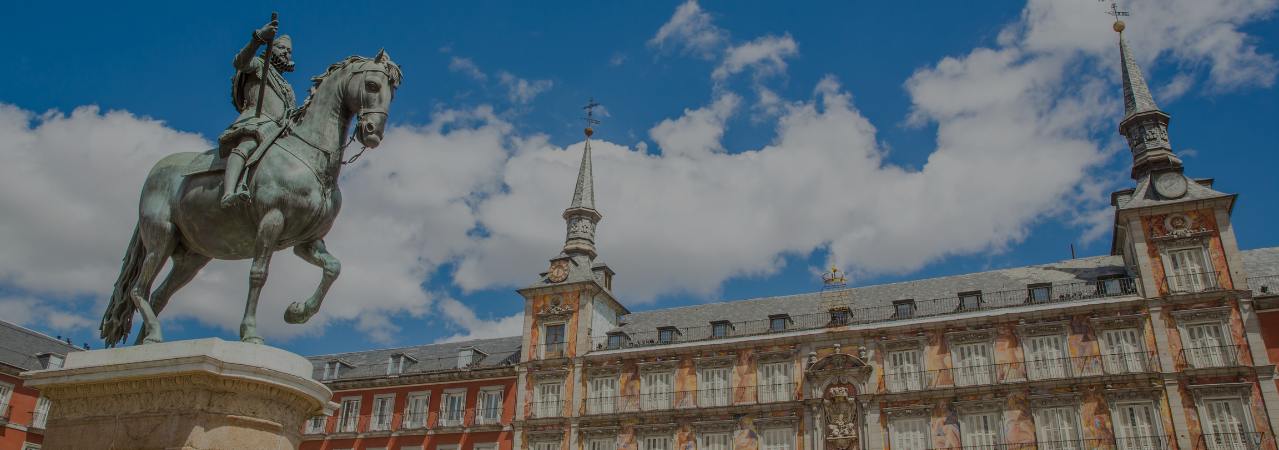
Plaza Mayor is a symbol of Madrid and must not be missed. Building work began on this huge open area in the city centre in the 17th century under the orders of Phillip III, whose bronze equestrian statue adorns the square. It was opened in 1620 and is rectangular in shape, with arcades running around the edges. This site used to be the venue for many public events, such as bullfights, processions and festivals. Underneath the arcades there are traditional shops, as well as a wealth of bars and restaurants.
The Barrio de las Letras is one of the most vibrant, cultural and characterful areas in central Madrid. Located between the Paseo del Prado and Puerta del Sol, it owes its name to the fact that, during Spain’s Golden Age, it was home to great literary figures such as Cervantes, Lope de Vega, Quevedo and Góngora. Walking its streets means stepping into the literary history of the country.
Pedestrian streets like Huertas display engraved excerpts from famous works on the pavement, inviting visitors to discover iconic quotes as they stroll. The neighbourhood blends tradition and modernity: restored historic buildings, charming bookshops, old theatres and cafés that preserve its bohemian essence.
It is also a key spot for enjoying culture in all its forms. You’ll find institutions such as CaixaForum and the Thyssen-Bornemisza Museum, and it is just steps away from the Prado Museum, forming part of the cultural environment of the Art Triangle. Its gastronomy stands out too, with traditional taverns, creative restaurants and lively terraces popular with both locals and visitors.
By day it is calm and perfect for relaxed walks; by night it comes alive with a warm, vibrant atmosphere. Altogether, the Barrio de las Letras is one of the areas that best represent Madrid’s blend of history, art and urban life.
The Paseo del Prado is one of Madrid’s most iconic and elegant boulevards, declared a UNESCO World Heritage Site as part of the Landscape of Light. This historic avenue, stretching from Plaza de Cibeles to Atocha station, is a place where art, science and nature coexist in a truly unique way.
Along the route lie three of the world’s most important museums: the Prado Museum, the Thyssen-Bornemisza Museum and the Reina Sofía Museum, forming the famous Art Triangle. This concentration of cultural institutions makes the Paseo del Prado an essential destination for art lovers and curious travellers alike.
The boulevard preserves its classic layout with a central garden, historic fountains and century-old trees, following part of the Enlightenment-era project promoted by Charles III in the 18th century. Among its most notable landmarks are the Neptune Fountain, the Cibeles Fountain and the Royal Botanical Garden, which adds a botanical and scientific dimension to the area.
Beyond its cultural and historical value, the Paseo del Prado is a pleasant space to walk, rest on its benches or enjoy the atmosphere of its cafés and terraces. It is one of the avenues that best reflects Madrid’s identity: open, monumental and deeply connected to art and history.
Plaza de Neptuno in Madrid is one of the main landmarks along Paseo del Prado and the starting point for all three Madrid City Tour sightseeing bus routes: Route 1: Historic Madrid, Route 2: Modern Madrid and Route 3: Madrid Today. Hop on at this stop to begin a panoramic tour of the capital’s main monuments, squares and neighbourhoods.
What is Plaza de Neptuno?
Plaza de Neptuno is the popular name given to Plaza de Cánovas del Castillo, which is dominated by one of Madrid’s most famous monumental fountains. Its central figure depicts Neptune, the Roman god of the sea, holding a trident while riding a shell-shaped chariot pulled by two sea horses.
The fountain formed part of the project to renovate the former Salón del Prado during the reign of Charles III. It was commissioned from the sculptor Juan Pascual de Mena and completed by several other artists following his death. The work was finished in 1786, and the monument was moved to the centre of its current location in the late 19th century.
Where is Plaza de Neptuno?
Plaza de Neptuno in Madrid is located in Plaza de Cánovas del Castillo, in the heart of Paseo del Prado. It lies between Plaza de Cibeles and Glorieta del Emperador Carlos V, in an area closely associated with the city’s art, culture and history.
Nearby attractions include the Prado National Museum, the Thyssen-Bornemisza National Museum, the Spanish Congress of Deputies, the Literary Quarter and some of Madrid’s best-known historic hotels.
How can you get to Plaza de Neptuno?
You can easily reach Plaza de Neptuno with Madrid City Tour, as this stop is the starting point for all three sightseeing bus routes. Route 1: Historic Madrid, Route 2: Modern Madrid and Route 3: Madrid Today all depart from here, allowing you to explore different areas and attractions across the capital.
Thanks to the hop-on hop-off system, you can begin your journey at Neptuno, get off at any stops you would like to visit and hop back on later to continue the route.
What can you do in Plaza de Neptuno?
The location of Plaza de Neptuno allows you to combine art, nature, architecture and cultural entertainment in a single visit. You can begin by admiring the details of the Neptune Fountain before walking along Paseo del Prado, with its gardens, fountains and historic buildings. Nearby you will find the Prado Museum and the Thyssen-Bornemisza National Museum, as well as the Literary Quarter and the Royal Botanical Garden. You can also continue your walk towards El Retiro Park or check the cultural programmes at Teatro de la Zarzuela and Círculo de Bellas Artes.
What can you see near Plaza de Neptuno?
The Plaza de Neptuno stop is an excellent starting point for visiting some of the main cultural and natural attractions in central Madrid.
- Teatro de la Zarzuela: Located behind the Spanish Congress of Deputies, it is the first and only theatre specifically dedicated to Spanish lyric theatre. It opened in 1856 and offers a programme focused on zarzuela, Spanish opera and other musical genres.
- El Retiro Park: One of Madrid’s largest green spaces. You can reach the park by walking along Calle Felipe IV or Calle Alfonso XII and visit landmarks such as the Great Pond, the Crystal Palace and the Statue Walk.
- Royal Botanical Garden: Located next to the Prado Museum, it contains collections of plants from different regions around the world. Its location was chosen as part of Charles III’s project to create a major complex dedicated to the natural sciences in this area of Madrid.
- Círculo de Bellas Artes: Founded in 1880, it is one of the most important private cultural centres in Europe. It organises exhibitions, conferences, artistic activities and film screenings. Its rooftop terrace offers panoramic views over central Madrid and the buildings lining Gran Vía.
Frequently asked questions
How far is Plaza de Cibeles from Plaza de Neptuno?
The walking distance between Plaza de Cibeles and Plaza de Neptuno is approximately 520 metres. The walk along Paseo del Prado usually takes between 6 and 8 minutes, although this may vary depending on your pace and the traffic lights along the route.
What is the history of the Neptune Fountain in Madrid?
The Neptune Fountain was created in the 18th century as part of the Salón del Prado project promoted by Charles III. Designed by Juan Pascual de Mena, it depicts the god Neptune riding a chariot pulled by sea horses and was moved to its current location in the late 19th century.
Which football team celebrates its victories in Plaza de Neptuno?
Atlético de Madrid traditionally celebrates its trophies and major sporting achievements around the Neptune Fountain. The club’s red-and-white supporters gather in the square, while Real Madrid celebrates its victories in the nearby Plaza de Cibeles.
How far is Atocha station from Plaza de Neptuno?
Madrid Atocha station is approximately 1.8 kilometres on foot from Plaza de Neptuno. The walk usually takes around 20 to 25 minutes, depending on which station exit you use. There are also direct city bus connections that allow you to complete the journey in just a few minutes.
Plaza de Cibeles is one of the most iconic and photographed places in Madrid, a must see spot for understanding the history, architecture, and character of the Spanish capital. Located right in the heart of the city, this square connects some of Madrid’s main avenues and has become a symbol recognized by both visitors and locals.
Its main landmark is the famous Cibeles Fountain, a monumental work that depicts the goddess Cybele on a chariot pulled by lions. Over time, this fountain has become one of Madrid’s great icons and a regular setting for celebrations and historic moments. Nearby stands the impressive Cibeles Palace, formerly the Palace of Communications, one of the most beautiful buildings in the city and now the headquarters of Madrid City Hall.
The square began to gain importance between the 18th and 19th centuries, when Madrid started to modernize and project a more monumental and representative image. Since then, Plaza de Cibeles has witnessed the city’s urban, political, and cultural evolution. Its value is not only architectural, but also symbolic, as it connects key areas such as Paseo del Prado, Calle de Alcalá, and the Salamanca district.
Today, visiting this area is a must for any traveler who wants to discover the essence of the capital. If you explore the city on the madrid cyt tour hop on hop off, the Cibeles stop is one of the best places to get off and enjoy this historic area at your own pace. From here, you can admire some of the most representative corners of the city center and continue your route comfortably on the tourist bus, enjoying one of the most important squares in Madrid.
Plaza de Colón in Madrid is dedicated to Christopher Columbus and the discovery of America. Hop on our sightseeing bus and explore one of the most representative areas of modern Madrid.
This well-known square combines monuments, gardens, cultural spaces and some of the capital’s most recognisable buildings.
What is Plaza de Colón?
Plaza de Colón is one of the main open spaces in central Madrid and an important connecting point between the districts of Justicia, Chamberí and Salamanca. Some of the city’s best-known streets and avenues converge here, including Calle Serrano, Calle Goya and Calle Génova, as well as Paseo de Recoletos and Paseo de la Castellana.
Its most representative feature is the Monument to Christopher Columbus, a white marble sculpture standing on a tall Neo-Gothic pedestal. The square is also home to the Gardens of Discovery, several sculptures dedicated to the discovery of America and one of the largest Spanish flags in the city.
What is the history of Plaza de Colón?
Plaza de Colón developed around the monument dedicated to Christopher Columbus, built between 1881 and 1885. The area was later transformed with the opening of the Gardens of Discovery in 1970 and the Monument to the Discovery of America in 1977. Following another renovation in 2008, the statue of Columbus returned to the centre of the roundabout, and the square became an established venue for institutional ceremonies, cultural events and public gatherings.
How can you get to Plaza de Colón?
Are you looking for the best way to reach Plaza de Colón in Madrid? Then you should try our sightseeing bus. With Madrid City Tour, you can hop on at any stop along Route 2: Modern Madrid and explore the city until you reach the Plaza de Colón stop, located at Paseo de la Castellana, 2.
Another convenient way to get there—although not quite as panoramic—is to take Metro line 4 and get off at Colón station, located next to the square.
What can you see in Plaza de Colón?
Plaza de Colón is close to some of Madrid’s most important monuments, museums and cultural spaces. From this stop, you can see the monument that gives the square its name and easily reach several of the capital’s must-see attractions.
- El Retiro Park: El Retiro Park is one of Madrid’s most iconic green spaces. From Plaza de Colón, you can walk to the entrances near Puerta de Alcalá and enjoy its gardens, the Great Pond, the Crystal Palace and its wide, tree-lined avenues.
- National Archaeological Museum: Located next to Plaza de Colón, the National Archaeological Museum offers a journey through the history of Spain, from Prehistory to the Modern Age. Its most notable pieces include the Lady of Elche, the Treasure of Guarrazar and an extensive collection of objects from Egyptian, Greek and Roman cultures.
- Puerta de Alcalá: Puerta de Alcalá is just a few minutes’ walk from Plaza de Colón. Built during the reign of Charles III, it is one of Madrid’s most representative monuments and marks one of the main entrances to El Retiro Park.
- National Library of Spain: The National Library of Spain occupies an imposing Neoclassical building on Paseo de Recoletos, next to the square. In addition to preserving a fundamental part of Spain’s bibliographic and documentary heritage, it organises exhibitions and activities that provide an insight into some of its historic collections.
- Monument to Christopher Columbus: The Monument to Christopher Columbus is the main symbol of the square. It consists of a white marble statue of the explorer standing on a tall Neo-Gothic pedestal decorated with reliefs related to his voyages and the discovery of America.
Frequently asked questions
What building is located in Plaza de Colón?
One of the most distinctive buildings in Plaza de Colón is the Torres de Colón, located next to Paseo de la Castellana. The surrounding area is also home to the National Library of Spain, the National Archaeological Museum and the Fernán Gómez Centro Cultural de la Villa.
How much does it cost to ice-skate in Plaza de Colón?
The ice rink in Plaza de Colón is a temporary installation that usually operates during the Christmas season, so the price may vary each year.
With the stop at the Museum of Natural Sciences, located on Paseo de la Castellana, it is very easy to explore one of Madrid’s most popular and fascinating museums. It is the perfect starting point for anyone curious about the history of our planet, dinosaurs, evolution, and the secrets of the animal world through its renowned collections.
What is the National Museum of Natural Sciences?
The National Museum of Natural Sciences (MNCN) is part of the Spanish National Research Council (CSIC) and has a history dating back to the 18th century. Its collections bring together millions of specimens related to zoology, geology, paleontology, and biodiversity.
In addition to its research work, the museum organizes exhibitions, activities, and workshops designed to bring science closer to visitors of all ages.
How to get to the National Museum of Natural Sciences
Located on Paseo de la Castellana and right next to the museum, this stop is the perfect excuse to take Route 2 (Madrid Modern) of Madrid City Tour. Forget about metro transfers or figuring out city bus lines; our double-decker bus takes you directly to the area. You can also enjoy panoramic views of the city during the ride and get off right at the entrance when you decide to start your visit.
You can also reach the area using public transport via Gregorio Marañón and Nuevos Ministerios stations.
What to see at the Museum of Natural Sciences
The visit includes some of the most well-known pieces from the permanent collection:
- Biodiversity hall, where specimens from different ecosystems can be seen.
- Paleontology collection, with fossils, skeletons, and dinosaur reconstructions.
- Whale skeleton, suspended above one of the main museum halls.
- Evolution mural, an outdoor piece summarizing millions of years of natural history.
- Exhibitions dedicated to minerals, birds, mammals, and major scientific expeditions.
It is especially recommended for families, although it is also highly interesting for anyone curious about nature and science.
Ticket prices and opening hours of the Museum of Natural Sciences
The museum is open Tuesday to Friday from 10:00 to 17:00, while on Saturdays, Sundays, and public holidays it remains open from 10:00 to 20:00. In August, opening hours are reduced to 10:00 to 15:00. It is closed on Mondays that are not public holidays, as well as on January 1st and 6th, May 1st, and December 25th.
General admission costs €7, while the reduced ticket is €3.50. In addition, certain groups can enter for free, including people over 65, children under 4, large families, and people with disabilities.
Frequently asked questions
When is admission free?
Admission is free for all visitors on Sundays from 17:00 to 20:00, except during the month of August.
Can you visit with pets?
Yes. Dogs are allowed inside the museum as long as they are kept on a leash and the museum rules are respected.
How long does the visit take?
Most visitors spend between two and three hours on the tour, although it can take longer if temporary exhibitions are visited or activities are attended.
The Estadio Santiago Bernabéu is the home stadium of the Real Madrid football team. Its name is in honour of the man who was president of the club for 35 years, Santiago Bernabéu. After various remodelling projects, it is today classified as an elite stadium, and holds the UEFA's highest distinction of five stars. The visit to the stadium includes access to Real Madrid's well-stocked trophy room, the presidential box and a chance to walk around the technical area and see the dressing rooms of the visiting team.
Nuevos Ministerios is one of those stops that perfectly reflects how Madrid has evolved over time. By getting off here on our sightseeing bus, you will find yourself in one of the most dynamic areas of the capital, where historic buildings, major avenues, cultural spaces and some of the city’s most important business centres come together.
Located next to Paseo de la Castellana, this area connects Madrid’s 20th-century heritage with the city’s most modern and cosmopolitan side.
What is Nuevos Ministerios in Madrid?
Although today Nuevos Ministerios is mainly associated with government offices and transport connections, its origins are linked to an ambitious urban transformation project. The complex was based on the design by architects Secundino Zuazo and Hermann Jansen, proposed in 1929 as part of Madrid’s expansion towards the north.
Construction began in the 1930s on the grounds previously occupied by Madrid’s old Hippodrome, which was replaced by a new area designed to reorganise the city and extend the Paseo de la Castellana axis.
The name “Nuevos Ministerios” reflects its original purpose: creating new administrative buildings adapted to the growth and development of the capital.
How to get to Nuevos Ministerios?
The Nuevos Ministerios stop on the Madrid City Tour is located in a privileged area, next to Paseo de la Castellana, one of Madrid’s most important avenues and one of the main routes that shape the city.
Our Route 2: Modern Madrid takes you directly to this area, allowing you to discover its architecture and main attractions without worrying about transport. Thanks to the hop-on hop-off system, you can get off to explore the surroundings and continue your journey whenever you are ready.
Another option is to use the metro or commuter trains. Nuevos Ministerios is one of Madrid’s busiest transport interchanges. It is connected to Metro lines 6, 8 and 10, as well as several Cercanías commuter train lines. Metro line 8 also provides a direct connection to Madrid-Barajas Airport.
What area is Nuevos Ministerios in?
This stop is located in one of the most representative areas of modern Madrid. The Paseo de la Castellana surroundings combine office buildings, shopping centres, cultural spaces and some of the city’s most iconic architectural landmarks.
It is particularly known for its business atmosphere during the week, although it also offers plenty of things to do for visitors thanks to its proximity to museums, stadiums and shopping areas.
Places you shouldn’t miss nearby
If you have time to explore the area on foot, these are some of the most interesting places to visit:
- National Museum of Natural Sciences: a must-visit for anyone interested in discovering the natural world through its zoology, geology and biodiversity collections.
- Santiago Bernabéu Stadium: one of Madrid’s greatest sporting landmarks. In addition to attending matches, visitors can take a tour to explore the museum and stadium facilities.
- Paseo de la Castellana: one of Madrid’s most important avenues, perfect for enjoying the city’s contemporary architecture and some of its most emblematic buildings.
Frequently asked questions
Which metro lines stop at Nuevos Ministerios?
Nuevos Ministerios is connected to Madrid Metro lines 6, 8 and 10, as well as several Cercanías commuter train lines. It is one of the main transport hubs in the city’s public transport network.
Are there any markets in Nuevos Ministerios?
The area hosts occasional events and temporary markets throughout the year, especially during special periods such as Christmas. The programme changes depending on the season, so it is advisable to check the available activities before your visit.
Where can you eat near Nuevos Ministerios?
The area around Nuevos Ministerios offers a wide range of dining options thanks to its location between business and commercial districts. In nearby streets such as Calle Orense, Raimundo Fernández Villaverde and the surrounding Paseo de la Castellana area, you will find restaurants, cafés and venues offering many different types of cuisine.
The Sorolla Museum is one of Madrid’s most charming and luminous spaces, a place where art, intimacy, and beauty blend in a unique way. Located in the former home and studio of painter Joaquín Sorolla, it preserves the essence of the artist: Andalusian-inspired gardens, fountains, the natural light coming through the windows, and personal objects that help visitors understand his daily life. The rooms display many of his most iconic works, especially Mediterranean landscapes, costumbrista scenes, and portraits filled with the unmistakable light that made Sorolla the master of Spanish luminism. Walking through this museum means entering his creative world, observing the colors, brushstrokes, and the constant presence of the sea in his work. Sketches, studies, and tools used by the painter are also preserved, offering insight into his artistic process. The garden, divided into three areas, is one of the most photographed corners for its calm and beauty. Located in the Chamberí district, the museum is easily accessible by metro (Gregorio Marañón, Ríos Rosas, or Iglesia). It is an ideal visit for those seeking an intimate, accessible, and light-filled museum in the heart of Madrid.
Calle Serrano is one of Madrid’s most exclusive and elegant streets and is located in the Barrio de Salamanca, one of the city’s most prestigious residential and shopping areas. It is well known for its luxury boutiques, international brands, jewellery stores, art galleries and high-end restaurants, making it an ideal place for a stroll or a refined shopping experience.
Beyond its commercial appeal, Calle Serrano stands out for its stately architecture and its proximity to iconic landmarks such as the National Archaeological Museum, the National Library, Paseo de la Castellana and Retiro Park. To explore this area comfortably, you can hop on the Madrid City Tour sightseeing bus and get off at the “Serrano” stop, the perfect starting point to discover one of Madrid’s most elegant districts.
The Puerta de Alcalá is one of Madrid’s most famous and photographed landmarks, as well as a true symbol of the city. It was commissioned in 1769 by King Charles III, who entrusted the project to architect Francisco Sabatini to commemorate his official arrival in the capital in 1778. The Puerta de Alcalá was part of Madrid’s former monumental gates, built when the city was still surrounded by walls, and marked the entrance from the Aragón road. Sabatini designed a neoclassical structure with five arches, three semicircular and two lintelled at the ends, an innovative design for its time. Located next to Retiro Park and Plaza de la Independencia, it is now a must-see sight and can be comfortably admired on board the hop on hop off Madrid City Tour, offering a panoramic view of this iconic monument. The Madrid City Tour route makes it easy to discover this historic landmark as part of modern Madrid, combining heritage, major avenues and green spaces.
Plaza Canalejas is one of the most elegant and strategically located urban spaces in central Madrid, a place where history, architecture, and modern life blend harmoniously. Located just a short walk from Puerta del Sol and the Literary Quarter, Canalejas Madrid has become a key area for both locals and visitors seeking charm, premium services, and a cosmopolitan atmosphere. Recently restored, the square stands out for its historic eclectic-style buildings, many of which have been renovated to recover their original beauty.
One of its major attractions is Galería Canalejas, a luxury shopping gallery housed within an exceptional architectural complex. Here you’ll find exclusive boutiques, international brands, gourmet spaces, and personalized services that make the visit truly sophisticated. Strolling through its corridors means enjoying a perfect blend of heritage and modernity.
Around Plaza Canalejas, iconic façades such as the former Palacio de la Equitativa—now a five-star hotel—add to the elegance of the area, along with lively streets that connect with some of Madrid’s most emblematic spots. Its location also provides easy access to the Carrera de San Jerónimo, Sevilla, Gran Vía, and the Huertas district.
Getting to Canalejas is very simple thanks to its excellent public transport connections: Sevilla metro station is just a few steps away, and several bus lines run nearby. Day or night, the square is an ideal meeting point for anyone who wants to enjoy the historic center with a touch of sophistication.
Plaza de Neptuno in Madrid is one of the main landmarks along Paseo del Prado and the starting point for all three Madrid City Tour sightseeing bus routes: Route 1: Historic Madrid, Route 2: Modern Madrid and Route 3: Madrid Today. Hop on at this stop to begin a panoramic tour of the capital’s main monuments, squares and neighbourhoods.
What is Plaza de Neptuno?
Plaza de Neptuno is the popular name given to Plaza de Cánovas del Castillo, which is dominated by one of Madrid’s most famous monumental fountains. Its central figure depicts Neptune, the Roman god of the sea, holding a trident while riding a shell-shaped chariot pulled by two sea horses.
The fountain formed part of the project to renovate the former Salón del Prado during the reign of Charles III. It was commissioned from the sculptor Juan Pascual de Mena and completed by several other artists following his death. The work was finished in 1786, and the monument was moved to the centre of its current location in the late 19th century.
Where is Plaza de Neptuno?
Plaza de Neptuno in Madrid is located in Plaza de Cánovas del Castillo, in the heart of Paseo del Prado. It lies between Plaza de Cibeles and Glorieta del Emperador Carlos V, in an area closely associated with the city’s art, culture and history.
Nearby attractions include the Prado National Museum, the Thyssen-Bornemisza National Museum, the Spanish Congress of Deputies, the Literary Quarter and some of Madrid’s best-known historic hotels.
How can you get to Plaza de Neptuno?
You can easily reach Plaza de Neptuno with Madrid City Tour, as this stop is the starting point for all three sightseeing bus routes. Route 1: Historic Madrid, Route 2: Modern Madrid and Route 3: Madrid Today all depart from here, allowing you to explore different areas and attractions across the capital.
Thanks to the hop-on hop-off system, you can begin your journey at Neptuno, get off at any stops you would like to visit and hop back on later to continue the route.
What can you do in Plaza de Neptuno?
The location of Plaza de Neptuno allows you to combine art, nature, architecture and cultural entertainment in a single visit. You can begin by admiring the details of the Neptune Fountain before walking along Paseo del Prado, with its gardens, fountains and historic buildings. Nearby you will find the Prado Museum and the Thyssen-Bornemisza National Museum, as well as the Literary Quarter and the Royal Botanical Garden. You can also continue your walk towards El Retiro Park or check the cultural programmes at Teatro de la Zarzuela and Círculo de Bellas Artes.
What can you see near Plaza de Neptuno?
The Plaza de Neptuno stop is an excellent starting point for visiting some of the main cultural and natural attractions in central Madrid.
- Teatro de la Zarzuela: Located behind the Spanish Congress of Deputies, it is the first and only theatre specifically dedicated to Spanish lyric theatre. It opened in 1856 and offers a programme focused on zarzuela, Spanish opera and other musical genres.
- El Retiro Park: One of Madrid’s largest green spaces. You can reach the park by walking along Calle Felipe IV or Calle Alfonso XII and visit landmarks such as the Great Pond, the Crystal Palace and the Statue Walk.
- Royal Botanical Garden: Located next to the Prado Museum, it contains collections of plants from different regions around the world. Its location was chosen as part of Charles III’s project to create a major complex dedicated to the natural sciences in this area of Madrid.
- Círculo de Bellas Artes: Founded in 1880, it is one of the most important private cultural centres in Europe. It organises exhibitions, conferences, artistic activities and film screenings. Its rooftop terrace offers panoramic views over central Madrid and the buildings lining Gran Vía.
Frequently asked questions
How far is Plaza de Cibeles from Plaza de Neptuno?
The walking distance between Plaza de Cibeles and Plaza de Neptuno is approximately 520 metres. The walk along Paseo del Prado usually takes between 6 and 8 minutes, although this may vary depending on your pace and the traffic lights along the route.
What is the history of the Neptune Fountain in Madrid?
The Neptune Fountain was created in the 18th century as part of the Salón del Prado project promoted by Charles III. Designed by Juan Pascual de Mena, it depicts the god Neptune riding a chariot pulled by sea horses and was moved to its current location in the late 19th century.
Which football team celebrates its victories in Plaza de Neptuno?
Atlético de Madrid traditionally celebrates its trophies and major sporting achievements around the Neptune Fountain. The club’s red-and-white supporters gather in the square, while Real Madrid celebrates its victories in the nearby Plaza de Cibeles.
How far is Atocha station from Plaza de Neptuno?
Madrid Atocha station is approximately 1.8 kilometres on foot from Plaza de Neptuno. The walk usually takes around 20 to 25 minutes, depending on which station exit you use. There are also direct city bus connections that allow you to complete the journey in just a few minutes.
The Alcalá area is one of the most emblematic parts of Madrid and one of the best places to discover the monumental essence of the capital. Set in a privileged location, it brings together history, architecture, culture, and some of the city’s most recognizable views. Very close to Retiro Park and Plaza de la Independencia, this area forms part of that elegant and stately Madrid that so many travelers want to experience.
Its main landmark is the Puerta de Alcalá, one of Madrid’s most iconic monuments. Built by order of Charles III and inaugurated in 1778, this monumental gate replaced an earlier one and was once one of the royal entrances to the city. Its neoclassical design has made it one of Madrid’s great historical and visual symbols.
The Puerta de Alcalá stands out for its elegance, its size, and its strategic location, as it presides over one of the most beautiful and busiest areas of the city. Beyond its architectural value, it represents an important part of Madrid’s urban evolution, when in the 18th century the city began to project a more monumental, modern, and representative image.
Today, walking through the Alcalá area means discovering a lively setting full of wide avenues, historic buildings, and highly photographed corners. It is also an ideal point to continue your visit toward Retiro, the Salamanca district, or the cultural axis of Paseo del Prado, which is why it has become an essential stop for those who want to get to know Madrid in depth.
If you visit the city with Madrid City Tour, this area is perfect for enjoying the hop on hop off experience in complete comfort. Thanks to the hop on hop off format, you can plan your route at your own pace, stop at the places that interest you most, and then continue the journey without rushing through the capital’s main attractions.
The Puerta de Alcalá stop is one of the most recommended on the route, as it allows you to admire this monument from a privileged perspective and easily access one of the city’s most elegant areas. From here, the Madrid tourist bus brings you to one of the capital’s most famous landmarks and invites you to keep discovering other must see places with the comfort of the hop on hop off service.
The Casa Árabe, also known as the Arabic House in Madrid, is one of the city’s most distinctive cultural spaces. Located in a beautiful Neo-Mudejar building on Calle de Alcalá, very close to Retiro Park, it stands out for its carefully restored architecture and its rich cultural programme focused on the Arab world.
Visitors can enjoy exhibitions at the Arabic House, film screenings, lectures, and educational activities designed to showcase the artistic and cultural diversity of the Middle East and North Africa. It has become a key meeting point for anyone looking for unique cultural experiences in Madrid.
The venue also features one of the most pleasant corners in the area: the Casa Árabe terrace, perfect for having a drink in a unique setting. There is also a restaurant offering flavours inspired by Arab and Mediterranean cuisine, often referred to simply as the Casa Árabe restaurant.
Thanks to its strategic location between the Salamanca district and Retiro Park, many visitors combine their cultural visit with a walk around the Retiro area, making Casa Árabe near Retiro an essential stop for discovering a different side of Madrid.
A place where architecture, culture, and gastronomy come together to offer an enriching experience in the heart of the city.
Calle de Goya is one of the most famous and vibrant commercial streets in the Salamanca district, right in the heart of Madrid’s most elegant area. Stretching from Plaza de Colón to Plaza de Manuel Becerra, it brings together fashion, gastronomy, local life and stately architecture.
Known as a shopping hotspot in Madrid, Goya combines major international brands, specialty boutiques, traditional shops and department stores such as El Corte Inglés, making it an essential stop for anyone who loves urban shopping and lively streets.
It also hosts cultural and sports venues like the WiZink Center, one of the city’s top arenas for concerts and events. Its surrounding streets—such as Alcalá, Serrano and Príncipe de Vergara—connect with one of Madrid’s most upscale and active areas.
Goya is also ideal for enjoying Madrid’s gastronomy, with classic cafés, modern restaurants and busy terraces popular among both locals and visitors. By day it’s a bustling commercial hub; by night it remains lively, safe and pleasant for strolling.
Overall, Calle de Goya represents the essence of elegant, vibrant and cosmopolitan Madrid, blending history, quality shopping and a distinctive urban lifestyle.
The Monumental Plaza de Toros de Las Ventas is one of Madrid’s most recognizable architectural and cultural landmarks. With a capacity for 23,798 spectators and a 60-meter-diameter arena, it is considered not only the most important bullring in Spain but also one of the largest and most prestigious in the world.
Its construction began based on a design by architect José Espelius, who did not live to see the project completed. After his death, Manuel Muñoz Monasterio finished the bullring in 1931, the same year it was officially inaugurated. The building is designed in the Neo-Mudéjar style, known for its exposed brickwork, horseshoe arches and intricate decoration that blends tradition and symbolism. Its exterior façade features hand-painted ceramic tiles depicting the coats of arms of all Spanish provinces, a tribute to national identity and the country’s bullfighting heritage.
In addition to hosting bullfights and major events—especially during the San Isidro Fair, one of the most important bullfighting festivals in the international calendar—Las Ventas is also an important cultural venue. Inside, it houses the Madrid Bullfighting Museum, which showcases the evolution of bullfighting through historic “traje de luces” costumes, famous bull heads, photographs, posters, artworks and pieces linked to legendary figures such as Manolete, Belmonte and Curro Romero. Even for visitors who are not fans of bullfighting, the museum is of great interest thanks to its historical and artistic perspective.
The Colón area is one of the most representative and elegant parts of Madrid, a key place to discover the city through culture, history, and grand avenues. Located between Paseo de la Castellana and Paseo de Recoletos, Plaza de Colón also connects with major streets such as Serrano, Goya, and Génova, giving it a strategic position right in the city center.
One of its main landmarks is the Columbus Monument, dedicated to Christopher Columbus and one of the most recognizable symbols of the square. This monumental ensemble reinforces the historic character of the area and helps explain the importance of this space within the city.
Nearby, you will also find the Gardens of Discovery, which bring openness and a calmer atmosphere to one of Madrid’s most dynamic areas. In addition, the surroundings of Colón are home to important sites such as the National Library and the National Archaeological Museum, making this visit a very complete experience.
The importance of Colón for Madrid is not only urban but also symbolic. It is a square that has gained prominence as a major open space in the capital and as a meeting point for events, cultural life, and movement between some of the city’s most outstanding districts.
Beyond its historical value, the Colón area stands out for its proximity to shopping areas, iconic buildings, and dining options, making it a very appealing stop for those who want to discover a more monumental and cosmopolitan side of Madrid.
If you explore the city with Madrid City Tour hop on hop off, the Colón stop is an excellent place to get off and discover this area at your own pace. From here, you can stroll through one of the capital’s most iconic districts, enjoy its monuments, and continue your route comfortably on the tourist bus while discovering Madrid your way.
The Bilbao area, located between the districts of Chamberí and Centro, is one of the liveliest and most characterful parts of Madrid. Its heart is the Glorieta de Bilbao, a historic roundabout where well-known streets like Luchana, Carranza and Fuencarral converge. The area is known for its youthful atmosphere, cultural life and a great mix of traditional bars, modern cafés and trendy spots.
The Bilbao metro station (lines 1 and 4) is one of the oldest in Madrid’s underground system, opened in 1919. Its entrances preserve the classic design of the early metro: iron railings, enamelled signage and a historic charm that make it an iconic stop. Thanks to its strategic location, it offers fast connections to Gran Vía, Sol, Nuevos Ministerios or Atocha, making it convenient for both locals and visitors.
Just steps from the roundabout begins Fuencarral Street, one of Madrid’s most important and vibrant shopping areas. This long pedestrian axis combines fashion stores, international brands, independent boutiques and alternative spaces, attracting young people, visitors and shopping lovers. The surrounding streets are full of theatres, cinemas, small shops and restaurants that give the neighbourhood its distinctive personality.
Bilbao is also known for its cultural scene: historic cinemas, concert venues and theatres coexist with bookshops, art galleries and creative spaces. By day it is perfect for walking and shopping; by night it becomes a lively area full of terraces, music and a great atmosphere.
Malasaña Madrid is one of the city’s most vibrant and creative areas, where traditional charm and an alternative spirit blend naturally. The Malasaña neighborhood in Madrid, located between Gran Vía and the University district, takes its name from Manuela Malasaña, although today it is known for its youthful and cultural energy. Walking through Malasaña neighborhood means discovering street art, independent shops, alternative bookstores, and cafés full of character. Plaza del Dos de Mayo, the neighborhood’s heart, perfectly reflects its bohemian spirit. It’s also an ideal place to enjoy a bar in Malasaña, whether for an evening drink or a night out among iconic venues and modern cocktail bars. Calle Fuencarral and its surroundings offer fashion, gastronomy, and unique spots to explore at your own pace. As for Malasaña how to get there, the easiest option is the metro: Tribunal, Noviciado, Bilbao, or Gran Vía stations leave you just minutes from the liveliest areas. Once there, the best plan is to wander the streets and let the neighborhood surprise you with its mix of history, creativity, and local life.
Plaza del Callao is one of the most iconic spots in callao madrid, strategically located between Gran Vía and the city’s main shopping area. Known for its historic cinemas, large screens and cosmopolitan atmosphere, plaza callao in Madrid is a meeting point for both locals and visitors. Walking through gran via plaza callao means diving into the most vibrant side of Madrid, surrounded by theatres, shops and landmark buildings. Plaza callao is also a key stop to explore the city on board the Madrid sightseeing bus. The Madrid City Tour route allows you to enjoy this area from a panoramic perspective thanks to its hop on hop off Madrid City Tour service, ideal for getting on and off at your own pace. The hop on hop off bus is one of the most comfortable ways to reach Callao and continue discovering Madrid’s main attractions without rushing.
Gran Vía is one of the most important and symbolic arteries of downtown Madrid, and in few places will you experience the hustle and bustle of this busy street. Lined with theatres, hotels, restaurants and cafés, thousands of residents and tourists stream along its pavements every day. Being located in the busy heart of Madrid it also has many souvenir shops, selling typical craft items, and traditional goods such as lace, mantilla shawls and fans.
You can't miss...


